
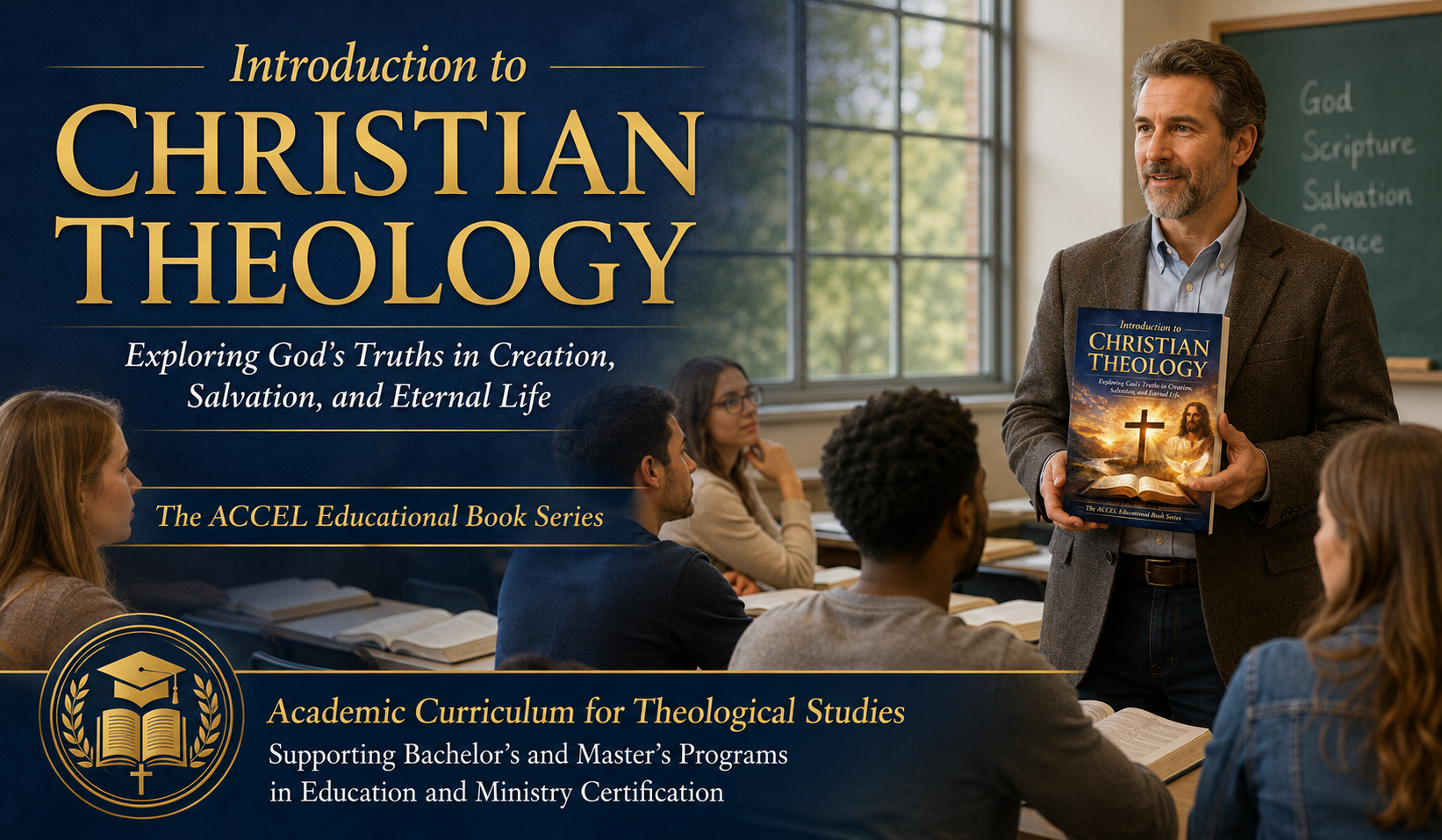
Introduction to Christian Theology: Foundations of Faith, Creation, Salvation, and Biblical Truth
The ACCEL Educational Book Series
Academic Curriculum for Theological Studies
Supporting Bachelor’s and Master’s Programs in Education and Ministry Certification
Introduction to Christian Theology
Christian theology stands at the heart of the Christian faith, providing believers, students, pastors, counselors, and ministry leaders with a deeper understanding of God, Scripture, salvation, and humanity’s divine purpose. Theology is not merely the study of religious ideas; it is the sacred exploration of God’s revelation through the Holy Bible. It seeks to illuminate eternal truths concerning creation, redemption, spiritual transformation, and the relationship between God and humanity.
Introduction to Christian Theology serves as a comprehensive guide for theological students, Christian educators, ministry leaders, and believers seeking spiritual growth and biblical understanding. Through careful study of Scripture, readers gain insight into the doctrines that have shaped Christianity throughout history while discovering how these truths remain profoundly relevant in modern life.
The Meaning and Purpose of Christian Theology
Christian theology is derived from two Greek words: Theos meaning God, and Logos meaning study or discourse. Theology, therefore, is the study of God and His relationship with creation. It examines divine revelation, biblical truth, and the spiritual principles that guide Christian living.
Theology provides believers with a framework for understanding:
- The nature and character of God
- The creation of the universe
- The purpose of humanity
- The problem of sin
- The plan of salvation
- The role of Jesus Christ
- The work of the Holy Spirit
- Eternal life and the afterlife
- Christian ethics and spiritual growth
Through theology, believers are strengthened in faith, equipped for ministry, and prepared to navigate life’s challenges with biblical wisdom and spiritual discernment.
Creation and Origins According to the Bible
God as the Creator of Heaven and Earth
The Bible begins with one of the most powerful declarations in all of Scripture:
“In the beginning, God created the heavens and the earth” (Genesis 1:1).
This foundational verse establishes God as the eternal Creator and Sovereign Ruler over all existence. The biblical account of creation reveals that the universe did not come into existence by accident but through the intentional design and divine authority of God.
The first chapters of Genesis describe the six days of creation:
- Creation of light
- Separation of the heavens and waters
- Formation of land and vegetation
- Creation of the sun, moon, and stars
- Creation of sea creatures and birds
- Creation of animals and humanity
Human beings were uniquely created in the image of God:
“So God created mankind in His own image” (Genesis 1:27).
This doctrine establishes the inherent value, dignity, and spiritual purpose of every human life. Humanity was designed for fellowship with God, stewardship over creation, and moral responsibility.
The Authority and Inspiration of Holy Scripture
Understanding the Bible as the Word of God
Christian theology recognizes the Bible as divinely inspired and authoritative. Scripture serves as the foundation for Christian doctrine, moral guidance, spiritual instruction, and theological understanding.
The Bible consists of:
- The Old Testament
- The New Testament
Together, these sacred writings reveal God’s covenant relationship with humanity and His redemptive plan through Jesus Christ.
According to 2 Timothy 3:16:
“All Scripture is God-breathed and is useful for teaching, rebuking, correcting and training in righteousness.”
The theological study of Scripture includes:
- Biblical interpretation
- Historical context
- Literary analysis
- Prophetic fulfillment
- Doctrinal teachings
- Spiritual application
The Bible remains relevant across generations because it addresses humanity’s deepest spiritual needs while revealing timeless truths about God’s love, justice, holiness, mercy, and redemption.
Conclusion
Introduction to Christian Theology offers a rich and transformative exploration of the Christian faith. Rooted in Scripture and strengthened by Christian tradition, this theological study provides readers with foundational understanding, spiritual insight, and practical application for everyday living.
By exploring creation, Scripture, the nature of God, the Trinity, Jesus Christ, salvation, the Holy Spirit, and eternity, believers are invited into a deeper relationship with God and a stronger commitment to faithful Christian living.
This work stands as a valuable resource for theological education, ministry preparation, spiritual development, and biblical leadership-helping readers grow in wisdom, faith, and understanding as they continue their journey with Christ.
Sold at bookshop.org
Book In English: https://bookshop.org/p/books/introduction-to-christian-theology-m-c-pinto/c99d1813c0395d8f?ean=9798295548734&next=t
Book In Portuguese: https://bookshop.org/p/books/introdu-o-teologia-crist-m-c-pinto/6b9bed4a7b4ada84?ean=9798295600470&next=t
Book In Spanish: https://bookshop.org/p/books/introducci-n-a-la-teolog-a-cristiana-m-c-pinto/09d43a4ddb5ad8c0?ean=9798295600494&next=t
Sold at Amazon
Book In English: https://a.co/d/001CydcX
Book In Portuguese: https://a.co/d/06vJmu51
Book In Spanish: https://a.co/d/08hElKv7
As well you can find online at other meager book stores
you can follow us at:
Instagram: acceleducational
and Facebook: ACCEL Educational